


Hábitats
HÁBITATS DE INTERÉS COMUNITARIO
8240 - * Pavimentos calcáreos
Ámbito: Terrestre (incl. fluvial) identificador: 8240 Prioritario: Sí
Nombre original EUR28
8240 - * Limestone pavementsDescripción original en inglés (EUR28)
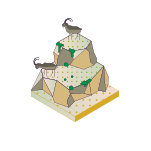
Regular blocks of limestone known as clints with loose flags separated by a network of vertical fissures known as grykes or shattered pavements, containing more loose limestone rubble. The rock surface is almost devoid of overlying soils (considerably less than 50% cover) except for some patches of shallow skeletal or loessic soils, although more extensive areas of deeper soil occasionally occur, sometimes there is encroachment of peat. This morphology offers a variety of microclimates allowing the establishment of complex vegetation consisting of a mosaic of different communities. The fissures provide a cold humid microclimate where shade-tolerant vascular plants such as Geranium robertianum and Ceterach officinale occur, as well as formations of herbaceous species typical of calcareous woodland, the small pockets of soil are occupied by communities of Mesobromion (e.g. Seslerio-Mesobromenion), heath and scrub also occur (e.g. Corylo-Fraxinetum). Apart from areas of species rich scrub (generally Prunetalia spinosae), the ecosystem is maintained by grazing in some regions, this, combined with severe winds, means that isolated shrubs can only survive in prostrate growth form (e.g. Dryas octopetala), at the margins of ungrazed sites Geranium sanguineum occurs. In Sweden, limestone blocks are larger and cracks are smaller. The species composition reflects a more continental, dryer and cooler climate. The pavements are mostly exposed with scattered cushions of bryophytes, more seldom covered by a thin layer of soil. The surface is covered by Sedum album, Cerastium pumilum, C. semidecandrum, lichens (Aspicilia calcarea, Thamnolia vermicularis, Verrucaria nigrescens) and bryophytes (Tortella tortuosa, Grimmia pulvinata). The vegetation in the cracks contains Gymnocarpium robertianum, Asplenium ruta-muraria, A. trichomanes ssp. quadrivalens and, occasionally, bushes of Prunus spinosa, Fraxinus excelsior, Cotoneaster spp., Rosa spp. Some sites in Ireland host an open Taxus-Juniperus scrub of major interest, certain arctic alpine species such as Gentiana verna and Dryas octopetala are characteristic and in The Burren, these species occur with Atlantic-Mediterranean species such as Neotinea maculata.Especies presentes (EUR28)
Correspondencias con otras clasificaciones (EUR28)
United Kingdom classification: W8 Fraxinus excelsior-Acer campestre-Mercurialis perennis woodland and W9 Fraxinus excelsior-Sorbus aucuparia-Mercurialis perennis woodland. Very locally in the United Kingdom, ancient woodland containing Tilia cordata occurs, which is of great conservation importance.